How to detect surface roughness after optical component processing?
Previous detection methods mainly used surface roughness testers, which can measure roughness as low as Ra around 5nm. The disadvantage is that the stylus tip needs to slide across the lens surface during measurement, inevitably causing scratches on the lens or coating surface. Therefore, it is necessary to adopt non-contact methods for detection.
Non-contact detection instruments are mainly optical instruments. Currently, many types of instruments can be used to measure surface roughness, with different accuracies and completely different principles. Compared with instruments such as spectral confocal, structured light 3D scanning, confocal microscopy, etc., white light interferometry is the non-contact detection method with the highest accuracy.
This time, using the Micro-Nano Profile Detection System, with an objective lens being our self-developed Mirau interferometric objective, we measured the surface roughness of a lens. After analyzing the surface interference fringes, the roughness after polishing was found to be Ra=0.00188um, which is 1.88nm.
Why not use a Fizeau interferometer for detection?
Fizeau interferometers are mainly used to measure the surface form accuracy of the entire processed surface, and are not sensitive to microscopic surface roughness. In addition, because the magnification of Fizeau interferometers is very low, microscopic surface defects are not easily observed. For surface defects such as scratches, conventional Fizeau interferometers basically cannot detect scratches at the micron level or even larger. White light interferometry, on the other hand, inherently has high magnification, can easily identify micron-level scratches on the surface, and can calculate the depth of scratches.
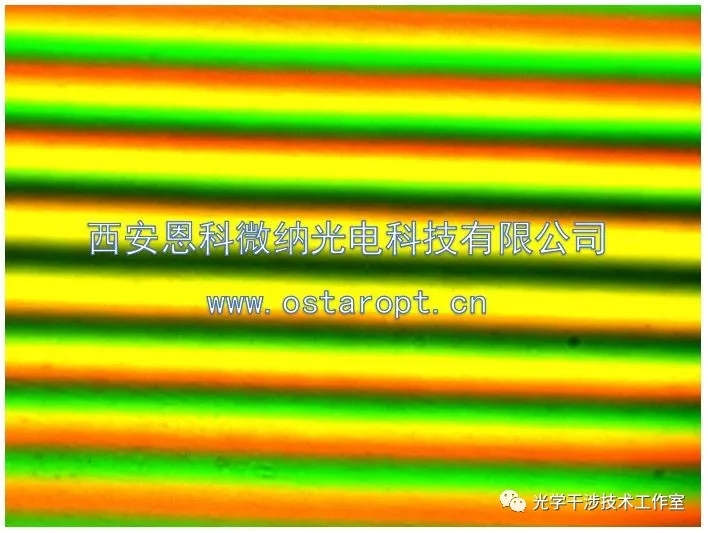
White light interference detection fringes on optical element surface

Software operation interface

Surface 3D profile
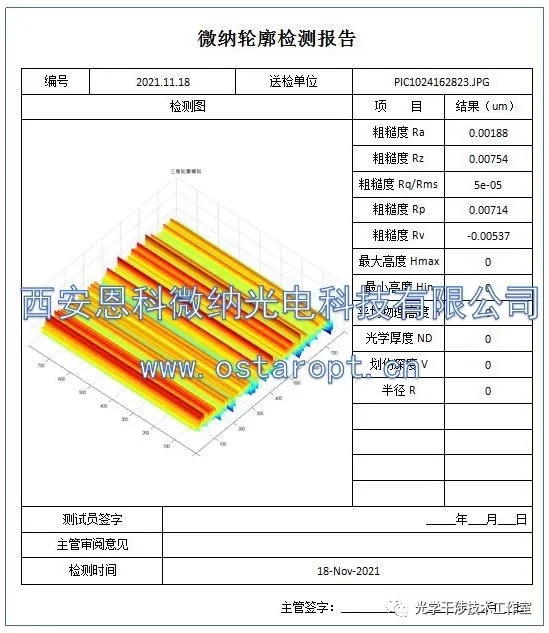
Test report









 QQ客服1
QQ客服1