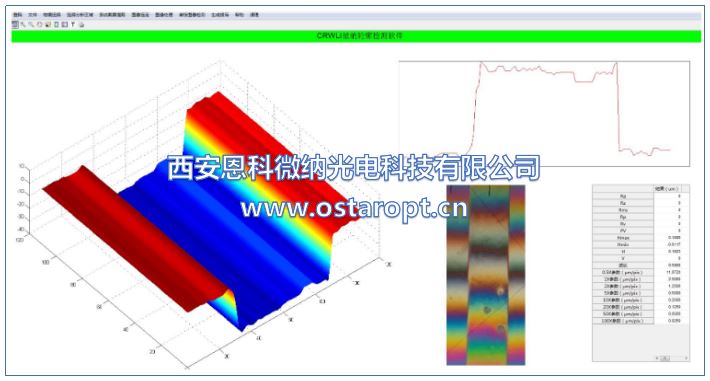
CRWLI Micro-nano Profile Detection Software Introduction
I. Software Application
CRWLI Micro-nano Profile Detection Software can be used with interference microscopes or other white light interferometric testing instruments. It is a software that analyzes the cross-sectional profile parameters of a region of interest from a single white light interferometric fringe image. Although it cannot detect the overall surface topography of a microscopic area, it still indirectly helps researchers analyze the surface profile status. This provides users with a more cost-effective and high-value option when selecting micro-nano surface profile detection instruments.
II. Software Description
This software is used for surface micro-nano profile analysis and detection. It imports a single white light interferometric fringe image, performs relevant operations, and finally detects relevant parameters, and can simulate the 3D surface profile.
Compared with white light interferometers for 3D surface topography detection, this software is an effective solution for achieving single‑position cross‑sectional profile detection and analysis at low cost.
III. Software Applications
1. Micro-nano surface damage depth detection
2. Surface micro-nano step detection
3. Roughness, groove profile and depth detection of multi‑groove plates
4. Micro-nano surface roughness detection: Ra, Rz, Rp, Rv, PV, Rms.
5. Coating film layer profile detection
6. Steel ball surface roughness detection
IV. Software Features
1. Unique algorithm for more accurate surface profile recognition
2. Only a white light interferometric fringe image is required to detect surface profile parameters
3. Capable of detecting surface roughness parameters, micro-nano steps, and multiple parameters of surface damage depth
4. The detected surface profile results can be simulated into a 3D topography for easier analysis
5. Automatic or manual calculation of 0.5λ available
6. Detection accuracy better than 10 nm
7. Detection report output in Word format
8. Suitable for samples with roughness Ra less than 2 μm, and step or scratch depth not exceeding 4 μm
V. Detection Case

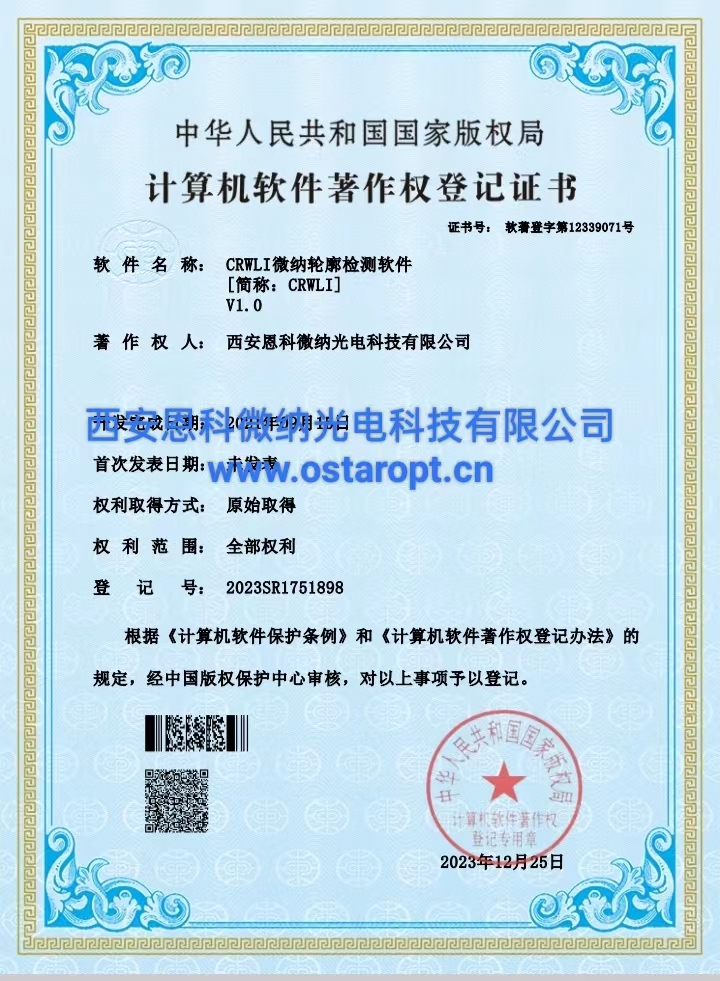
VI. Software Copyright









 QQ客服1
QQ客服1